

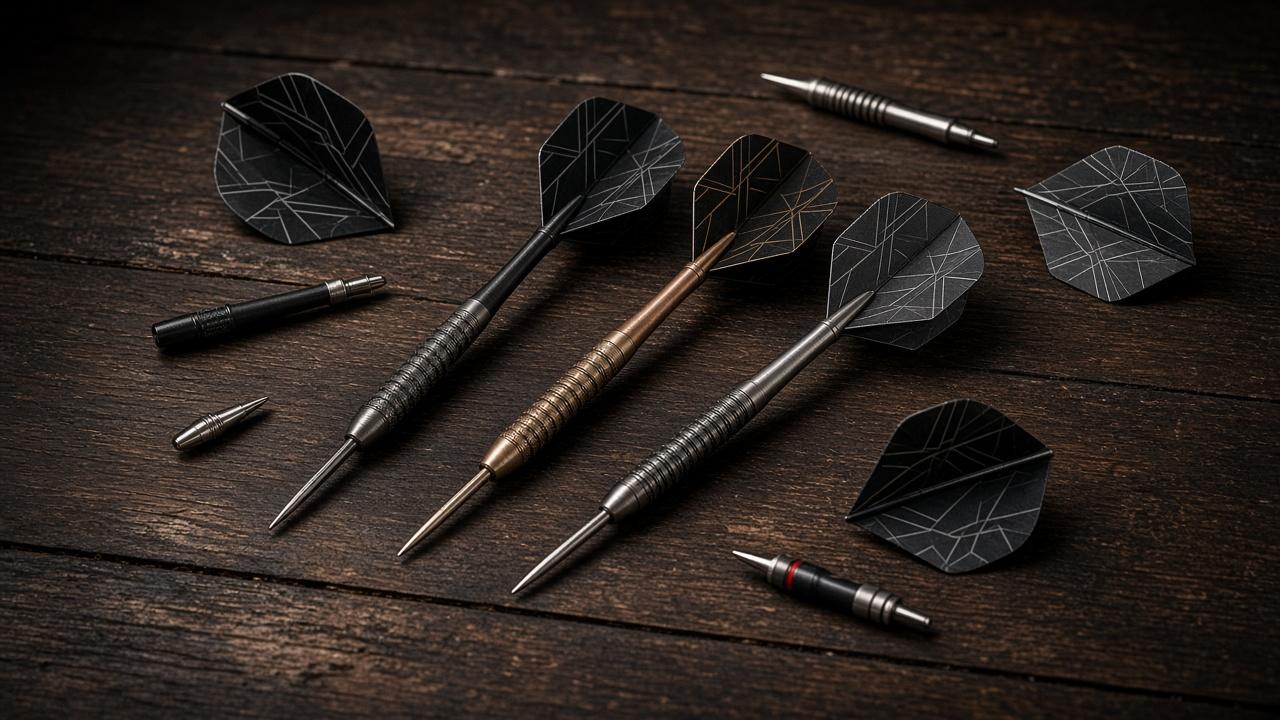
You play darts, but the arrows land everywhere except where you aim. That is rarely about talent. Usually you lack a clear plan.
This guide shows how to improve systematically as a beginner: clean throwing technique, targeted drills, a realistic four-week plan, and the mistakes that slow most players down.
What you should be able to do after four weeks
- a fixed stance and a repeatable motion
- hit triple 20 and simple doubles on purpose
- train 30–40 minutes with focus instead of random throws
- know when a darts coach is worth it
1. Basics: technique and equipment
Stance
Feet about shoulder-width apart, weight slightly forward. Keep the upper body still. Your foot position stays the same for the whole session. Changing stance every round makes progress impossible to measure.
Grip
Hold the dart lightly. Too much pressure creates wild releases. Thumb and index finger give stability; the other fingers guide. If your fingers go white after a throw, you are gripping too hard.
Arm motion and follow-through
The movement comes from the forearm. Shoulder and torso stay quiet. After release, your hand still points at the target. Without follow-through, darts scatter.
Equipment for getting started
- Darts: often 18–22 g, as long as they feel natural in your hand
- Board: steel for classic training, soft-tip as a supplement
- Same oche and board distance every time
More detail on motion: Improve your throwing technique.
2. Ten drills that actually help
- Around the Clock – Numbers 1–20 in order. Move on only when the segment is reliable.
- Bullseye – 20–30 darts at the centre. Count hits.
- 501 Light – No match pressure; focus on checkout routes.
- Single-segment drill – One bed (e.g. 16) for several rounds.
- Triple training – T20, T19, T18 in rotation.
- Checkouts – Standard finishes such as 81, 100, 121.
- Bob's 27 – Systematic doubles from D1 to D20.
- Random doubles – Random doubles under light pressure.
- Pressure drill – Time limit or minimum hits per round.
- Match simulation – Best-of against yourself or a partner.
Full descriptions: Darts training drills.
3. Four-week training plan
Weeks 1–2 (30 minutes each)
- Monday: Around the Clock + Bullseye
- Wednesday: Single-segment + 501 Light
- Friday: Doubles + checkouts
Weeks 3–4 (35–40 minutes each)
- Monday: Triple training + checkouts
- Wednesday: Pressure drill + match simulation
- Friday: Mix of your weakest drills from the week
Three to four sessions per week is enough. Longer than 45 minutes rarely helps beginners once focus drops.
A fuller structure lives in the darts training plan guide.
4. Typical beginner mistakes
- No plan, only triple 20
- Ignoring doubles until a match decides it
- Technique errors repeated for months
- Sessions too long, focus gone
- No feedback from outside
If the same errors stay, book a trial with a darts coach near you.
5. Mental basics
- a short routine before every throw
- picture the target briefly
- drop the last miss; the next dart counts
- breathe steadily, especially on doubles
FAQ
Next step
Run the plan for two weeks. In parallel, find clubs and venues in your area. How to filter “near me” is covered in Play darts near me. If you want faster progress, compare darts coaches and ask for a trial session.